
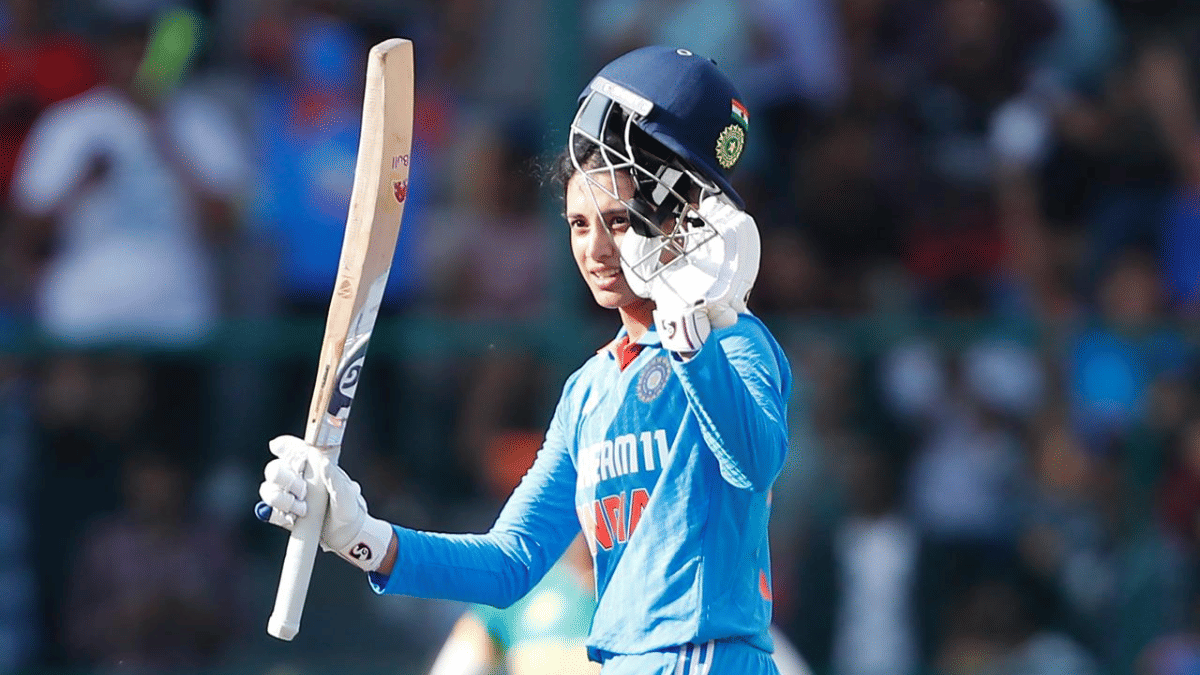

Smriti Mandhana batted against Hong Kong in a Women’s Asia Cup matchon 3 September. India were expected to win easily. By the time shewalked toward the pavilion,the left-handed opening batterhad broken four cricket records in that single innings. It made news. Cricket fans talked about it;news portalscovered it. However,the news stayed confined to a small echo chamberand did not travel much beyond that.
Mandhana scored124 off 64 balls, with 14 fours and 7 sixes. When she crossed 112, she went pastformer women’s team captainMithali Raj’stallyof 10,868 international runs,becoming the all-time leading run-scorer in women’s international cricket. Mandhana nowcomfortably sits at the top of the table with 11,000 runs.
Her hundred against Hong Kong was her18thin international cricket, taking her past Australia’s Meg Lanning and South Africa’s Laura Wolvaardt, both tied on 17. She now holds the record for the most international centuries scored by any woman. Mandhana also became the first Indian woman with two T20 International (T20I) hundreds and broke the tournament’s (Asia Cup) individual-innings record, too, goingpastSri Lankan skipperChamari Athapaththu’s 119.
Long story short, one innings, four records.
Mandhana is no stranger to record-breaking. In Septemberlast year, in an ODI match against Australia, shescoreda century off just 50 balls, the fastest by any Indian, surpassing Virat Kohli—who also achieved the feat againstAustralia in October 2013.Hetook 52 balls to reach his hundred.Coincidentally, Mandhana made her senior international debut for India in 2013.
In October 2025, during India’s first-ever Women’s ODI World Cup win, Mandhana became thefastestIndian batter to reach 5,000 ODI runs in just 112 innings, 32 fewer than Mithali Raj. Virat Kohli, arguably the finest batter of the present generation, took 114 innings to reach thesimilarfeat.
Where she started
None of this happened by accident. Mandhana grew up in Madhavnagar, a neighbourhood in Sangli,Maharashtra. She played cricket on weekendswith her father and elder brother before being selected for Maharashtra’s Under-15 team. Mandhana was nine years old at that time.
At 17, she scored 224 in a domestic match, the first double century by an Indian woman at that level. In less than a year, Mandhana was playing for India. By the time she turned 22, she was the youngestIndianT20I captain the format had seen. This February, captaining RCB in a Women’s Premier League(WPL)final chase of 204, shescored87 off 41 balls, smashing the fastest fifty in any WPL final (in 23 deliveries).
Mandhana’s coach latersaidshe was down with a high fever on the eve of the game, yet did her job. She played with so much control and conviction that her teammates could not even remotely think that she was unwell.
That’s the player Smriti Mandhana. Given her spectacular success and unmatched performance, the question that ought to bother us is: why does a peerless dominance of this kind not make it to the front page?
A gendered game
Sports, like most institutions, in a markedly concrete sense,have always beengendered. The same feat, as is quite clear, gets recognised differently. Mandhana’s relative invisibility testifies that it is not as much about the record per se as it is about who hasachievedit.
If Virat Kohli or Rohit Sharma had broken a career run record, the fastest-century record, and highest centuries record in the same year, it would not have been just another sports story. It wouldhave beenan occasion for national celebration.Itwould have dominated television debates and headlines, graced newspaper front pages, and figured in public discussions for weeks. Mandhana broke all three records and yet her achievements remained largely confined to the sports pages.
This is not only an Indian story. TheUSwomen’s football team has won four World Cups. The men’s team, on the contrary, has never won one. Nonetheless, after years of legal disputes, it was only in 2022 that the team won an equal-payagreementwith the US Soccer Federation. If the most successful team in the country’s sports history had to fight for years just to be paid the same as the men’s team (far less successful beyond doubt), the gap was never really about performance.
The attention gap tracks the pay gap, and both track something older—an assumption that women’s sport is a lesser version of the real thing, worth covering once the results make a case for it. A2023 studybyWasserman’s The Collective, done withESPN Research, found women’s sports drew about 15per centof the US sports media coverage in 2022, up from a long-accepted baseline of 3-5.5 per cent. Though things have somewhat improved, parity remains a distant dream.
India’s own record makes the same point. The BCCI equalised per-match fees in 2022, but the annual retainer contracts underneath them are nowhere close. The top grade for men pays Rs 7 crores a year whereas the top grade for women, Mandhana’s own grade, pays Rs 50 lakhs. As we ponder over this gap, we must not lose sight of its structural aspect. India’s female cricketers play far fewer international matches a year than their male counterparts. Therefore, match fees alonewon’tclose the gap. Moreover, it is important to underline that identifying something as structural is not to identify it as fair.
India won its first Women’s ODI World Cup in 2025. Needless to mention, though not at par with what we witnessed in 2011 when the men’s team bagged the coveted trophy — coverage now is far more impressive. The gap is closing but, thanks to the way gender as a category informs recognition, it remains. What we observe is that records, zeal, performance under pressure and so forth do not carry an independent value. Our celebration of these, unfortunately, depends on who is standing at the crease.
In February 2027, India is going to host the first-ever ICC Women’s Champions Trophy, to be held in Mumbai and Vadodara. These are venues where Mandhana has spent the last year and a half breaking records one after another. More will be broken when she walks on the ground. Let us hope that Mandhana gains the recognition she rightfully deserves, and that her achievements do not end up as footnotes in subcontinental cricket’s history.
Kapil Gupta is an assistant professor at the IIM, Kozhikode.
Nine Years, Made Possible by Readers
In 2017, Shekhar Gupta started ThePrint with a simple belief: Indian readers want journalism that asks why and what next, not just what. And that enough of them would be willing to pay for good journalism.
Nine years on, that belief has held.
And, in these nine years, we’ve stayed true to our mission. We’ve been asking the follow-up questions, going beyond the headlines and explaining what’s actually happening. We’ve travelled across the country to bring you in-depth, visually-compelling stories from the ground.
It’s been nine years of readers choosing to make this possible. If you’d like to be one of them:
- Tags
- gender gap
- Indian women’s cricket
- Smriti Mandhana
Source: theprint.in