


Ben Stokes is running out of answers.
He comes down the pitch. Misses. Tries to defend. Beaten. Moves away to make room. Still cannot get a run.
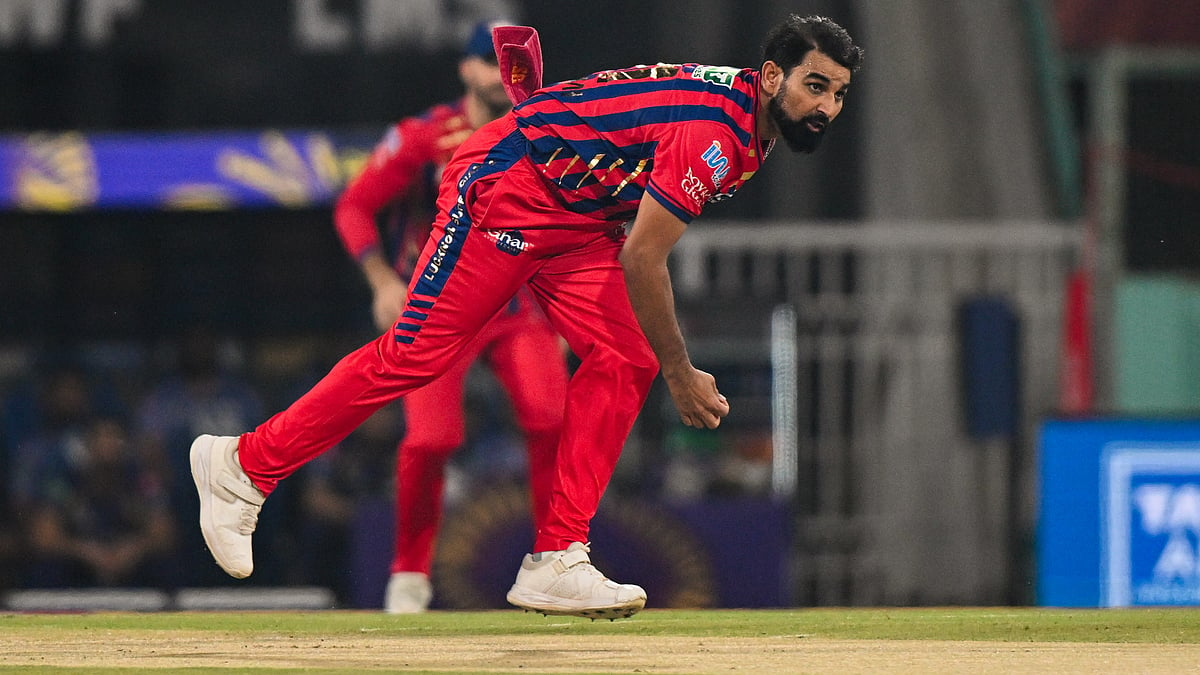
Lucknow. October 29, 2023. Mohammed Shami is taking apart one of cricket’s great problem-solvers, a delivery at a time. The ball threatens the bat, escapes it, returns to ask another question. Stokes has faced nine deliveries. His score has not moved.
Then he backs away and swings. The stumps go.
In its ball-by-ball analysis, the ICC traced the dismissal through changes of length, movement and the room Stokes kept trying to manufacture. Michael Atherton supplied the verdict: “He kept Ben Stokes under lock and key.”
Ten balls. No runs. An innings reduced to an escape attempt. ICC analysis

Open Magazine Latest Edition is Out Now!
What Rahul Gandhi Wants
28 Aug 2026 – Vol 05 | Issue 35
He is desperately courting the angry youth
He is desperately courting the angry youth. That won’t be enough to credibly challenge Modi
There is an entire Shami profile in that passage of play: the repetition, the adjustments so small they can disappear at full speed, the refusal to offer relief.
But there is another scene that belongs beside it.
Shami, after surgery, trying to put his foot on the floor.
The man who could make a batter afraid to move had become afraid of moving himself.
In an interview published by the ICC
In an interview published by the ICC in February 2025, he recalled asking his doctor how soon he could return to the field. The doctor’s priorities were more elementary: walking, jogging, running. Cricket would have to wait. When he was allowed to put his foot down after 60 days, even that frightened him.
“Like a toddler learning how to walk,” he said.
The distance between those two scenes is the distance a scorecard cannot measure.
On the eve of the Duleep Trophy final between East Zone and South Zone in Chennai, Shami stood at 99 first-class appearances and 382 wickets. According to ANI’s September 5 report, the final would be his hundredth. He thanked the Cricket Association of Bengal, his family, coaches, teammates and supporters.
“100 matches, countless memories and the journey continues,” he wrote on Instagram.
A fast bowler’s century. Count the journeys back to the crease. Then count the journeys required to get back onto a cricket ground at all.
For Shami, the second number gives the first its weight.
The early journey took him from Sahaspur
The early journey took him from Sahaspur in Uttar Pradesh to Kolkata. He had missed out on the Uttar Pradesh under-19 side. His coach, Badruddin Siddique, urged a move to Bengal, where club cricket offered another route. The village boy needed somewhere to bowl. He also needed somewhere to live.
ESPNcricinfo’s 2013 account traced the intervention of Town Club’s Debabrata Das, who brought Shami into his home. A cricket career advanced because someone made room for it at the dinner table.
Das remembered what held the youngster’s attention: “His goal was the stumps, the sound that comes from hitting the stumps.”
Listen to that sentence
Listen to that sentence. Before the television replays and the World Cup montages, there was a boy chasing a sound.
There was also an unusual appetite for used cricket balls.
Siddique reportedly said in November 2013 that, during junior tournaments around Moradabad, Shami would ask organisers for the old red balls. He was working on reverse swing from his age-group days. The scuffed ball had lessons left in it.
That detail helps explain the bowler he became. Fast bowling asks a player to understand an object that changes while he is using it. The shine goes. The surface roughens. The ball that offered one possibility at the start of an innings may offer another later.
Shami learnt to keep asking.
When he made his Test debut against West
When he made his Test debut against West Indies at Eden Gardens in November 2013, the old ball became his announcement: nine wickets, with reverse swing central to the damage. The boy who had needed Bengal to give him a chance was making India watch.
To understand why batters find him so difficult, look at the wrist.
In a January 2019 analysis, former India opener Aakash Chopra described the cocked wrist and the fingers coming down straight at release, producing that remarkably upright seam. He highlighted Shami’s ability to generate sideways movement after pitching without the seam wobbling.
The movement need not be extravagant. A small de. One delivery threatens the outside edge; another brings the stumps into play. Shami’s repeatable release makes the uncertainty particularly uncomfortable: the action looks reassuringly familiar while the outcome refuses to be
This is a craftsman’s kind of violence
This is a craftsman’s kind of violence. The damage comes from getting a small thing right, again and again.
His Test bowling could also become brutally physical. In Perth in December 2018, he took six for 56. In fact, Shami took four wickets in five overs as he exploited the uneven bounce. A settled innings could suddenly lose its shape when Shami found his spell.
Yet he understood that fast bowling was a shared occupation. Speaking after that performance, in comments carried by the ICC, he stressed the importance of the bowler at the other end and praised Ishant Sharma, Jasprit Bumrah and Umesh Yadav.
Pressure had to survive the change of ends.
For India, that attack expanded the possibilities
For India, that attack expanded the possibilities of overseas Test cricket. For Shami, maintaining his place in it meant repeatedly negotiating with his body.
After the 2015 World Cup, knee surgery left him dependent on others for basic movement. In an interview with BCCI.tv that year, he described being bedridden and needing help even to get to the bathroom.
“That was a very tough time for me,” he said.
Imagine the professional adjustment contained in that account. A fast bowler spends his working life generating momentum. Then the day’s achievement becomes getting across a room.
The harder passages of Shami’s life cannot all be filed under injury.
In 2018, his wife, Hasin Jahan, accused him
In 2018, his wife, Hasin Jahan, accused him of domestic violence; Shami denied the allegations. His central contract was initially withheld.
Two years later, in an Instagram conversation with Rohit Sharma, Shami spoke about having experienced suicidal thoughts during a period of severe personal distress. He credited his family’s support with helping him through it and keeping his cricket career alive.
There is a temptation in sports writing to hurry through such an admission towards the next five-wicket haul. The wickets make the ending easier.
His account deserves more care
His account deserves more care. The people around him mattered. Their presence belongs in this story as surely as any coach’s correction of his wrist.
In October 2021, another ugliness arrived. After India lost to Pakistan in the T20 World Cup, Shami was targeted with Islamophobic abuse online. Reuters reported how a collective team failure had been turned into an attack on its Muslim fast bowler. Former players rallied around him. Reuters report
He owed that mob no sporting proof of his belonging. A bad night with the ball should never have become a citizenship test.
Meanwhile, the work continued.
Shami built a pitch, nets and a clay
Shami built a pitch, nets and a clay running track at his Amroha farmhouse in early 2020. Home gave him a place to keep preparing. Asked about his routine during the 2023 World Cup, he explained that training itself helped him relax.
That is a useful correction to the mythology of natural talent. The seam seen on television has a long life away from television.
In 2023, he also won the IPL’s Purple Cap for Gujarat Titans, taking 28 wickets in 17 matches. His craft travelled across formats.
Then came the World Cup that would become inseparable from his name.
He sat out India’s opening four matches
He sat out India’s opening four matches. Once his opportunity arrived, he took five for 54 against New Zealand in Dharamsala. England followed, with four for 22 and that demolition of Stokes. Against Sri Lanka, five for 18.
In the semi-final at the Wankhede, New Zealand were pursuing 398. Daryl Mitchell made 134. Shami took seven for 57, dragging the match away from a challenger that kept refusing to disappear.
Seven wickets in a World Cup semi-final. There are performances that improve a reputation. This one became part of the definition. He finished the tournament with 24 wickets in seven appearances at an average of 10.70, the competition’s leading wicket-taker.
India still lost the final to Australia
India still lost the final to Australia. The finest tournament of his life ended with somebody else lifting the cup.
Then came the operation and the question of whether he would play again.
The return eventually came. In the 2025 Champions Trophy opener against Bangladesh, he took five wickets and reached 200 ODI wickets. He took 5,126 deliveries to reach the landmark, fewer than any bowler before him.
That statistic gets close to the essence of Shami. Measure the time between wickets. He has spent a career shortening it.
Australia’s Cooper Connolly encountered him in the semi-final
Australia’s Cooper Connolly encountered him in the semi-final and was dismissed by an outswinger. Later, in comments carried by the ICC, the young batter offered a plain assessment: “Shami is a world class player for a reason.”
This time, India won the tournament. Shami had nine wickets in the title-winning campaign. ICC player profile
And still, there was more domestic cricket to play.
Now he is back in East Zone colours, with five wickets in the Duleep Trophy and another India recall to chase. A hundred first-class matches behind him. Still bowling for what might come next. But past greatness cannot make that selection automatic. The body must withstand the overs. The bowling must make its case.
There is dignity in his willingness to submit to that examination again.
The felicitation recognises what he has already done
The felicitation recognises what he has already done. The next spell asks what he can still do.
Somewhere between the two stands the boy who collected old cricket balls, the young man offered a home in Kolkata, the patient learning to trust his foot and the fast bowler who gave Ben Stokes nowhere to go.
A hundred matches contain all those men. At the end of his run-up, Shami still has something to say.
With inputs from ANI & agencies
Source: openthemagazine.com


1 Comment
Pingback: ‘You don’t need anyone else's support': Rajat Patidar opens up on Virat Kohli backing him for RCB captaincy - Cricket Express